
NHS patients, staff and campaigners protest corridor care outside Parliament

FOR IMMEDIATE USE: NHS patients, staff and campaigners protest corridor care outside Parliament
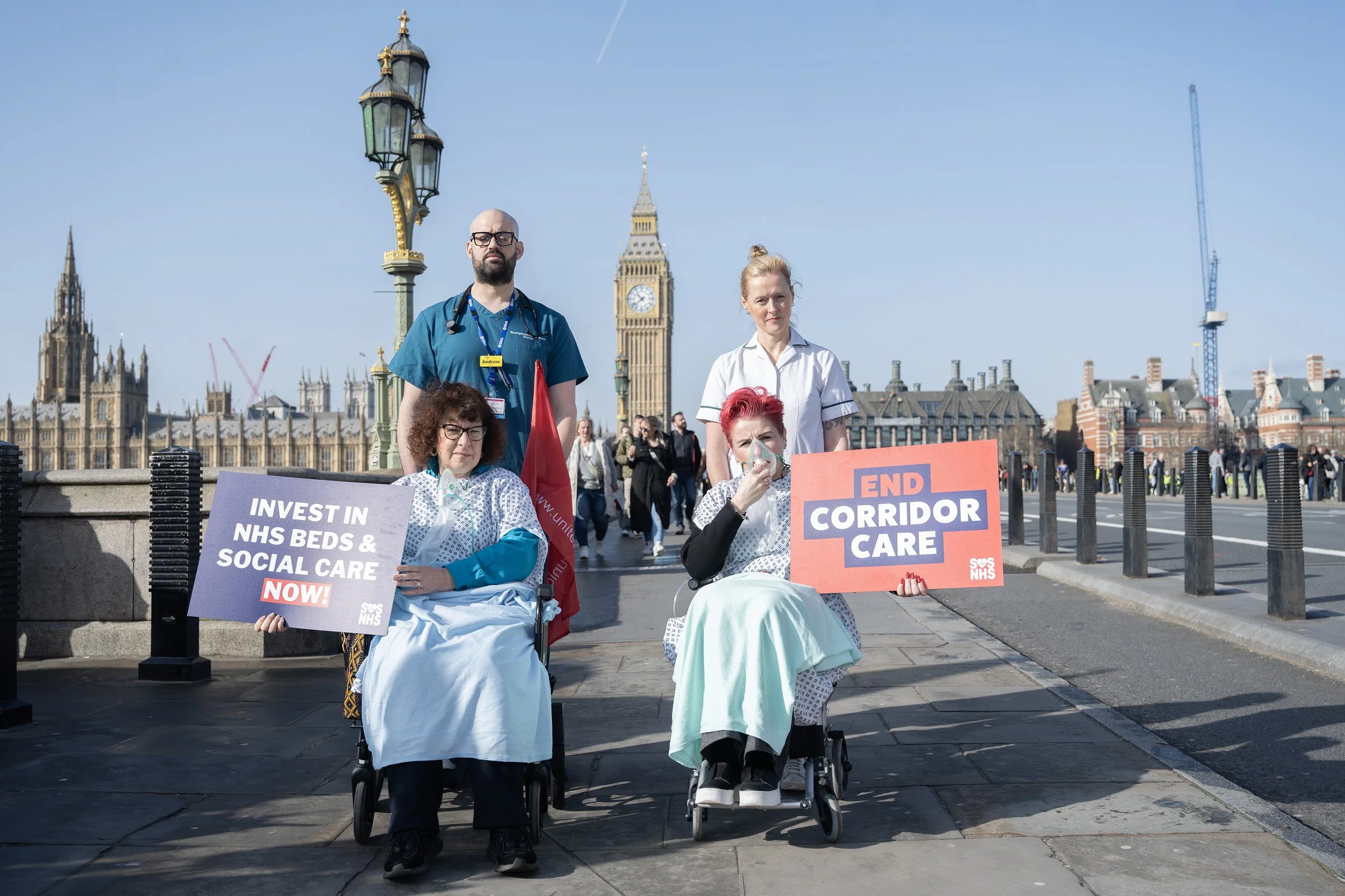
On Wednesday 25th February, NHS staff, patients and campaigners from the SOS NHS alliance [1] held a visual stunt at Parliament Square, to demand urgent action to end the crisis of corridor care. MPs from across all political parties were invited to attend and those that came along were presented with a briefing which outlines the issues and the groups demands. Read it HERE.
SOS NHS is the largest coalition yet formed in defence of the NHS, comprised of campaign groups, trade unions, health and care staff, social movements and civil society organisations. The coalition believe there is an urgent need to reopen almost 5,000 NHS beds that have not been used since the pandemic began. To stop the continued worsening of the crisis in the NHS, the coalition is calling on the government to take immediate, concrete steps to relieve the crisis in hospitals by reinstating beds that have been lost and investing in the staff to operate them, as well as funding and addressing the crisis in social care.
NHS staff and health campaigners along with affected patients and their relatives assembled along with hospital equipment and props visually reminiscent of a corridor care situation, in order to draw attention to the ongoing and dangerous situation of corridor care which is now a routine situation in hospitals across the UK.
Hospitals across the UK are increasingly relying on so-called “corridor care”, with patients left waiting for hours or even days on trolleys in corridors, ambulances, and other unsuitable spaces due to critical shortages of beds, staff and social care capacity. This unsafe and undignified practice is costing lives: the Royal College of Emergency Medicine estimates that more than 16,000 avoidable deaths occur each year in the emergency care pathway as a result of delays [2].
Campaigners warn that the crisis is driven by years of underinvestment, with almost 5,000 NHS beds still closed since the pandemic, leaving emergency departments overwhelmed and unable to deliver timely, life-saving care. Without urgent government action to restore bed capacity and properly fund staffing and social care, patients will continue to suffer and die needlessly.
Official photographs of the action available via this link: https://drive.google.com/drive/folders/1ZhkV7mxhGmmLGxQm6Vtmsm45_sdNOCrk
Müge Dindjer, NHS patient, says:
"My life was put at risk after an agonising 12 hour wait in A&E. I was saved by emergency surgery, but I am heartbroken that thousands of other patients have needlessly lost their lives due to urgent care delays. Over Christmas my sister had to be treated in an 'ambulance drop off site' where a fellow patient died alone in the night, out of sight of any staff. No patient should be being treated - or forced to wait for treatment - in these under-resourced and inappropriate spaces. If the government is serious about ending corridor care by 2029, they must deliver the investment in NHS beds and social care that is urgently needed in order to save lives."
Andrew Meyerson, A&E Resident Doctor, says:
“Corridor care isn’t just undignified, it’s a symptom of a much larger problem of NHS emergency delays that kill 15-20,000 people every single year. As an A&E doctor caring for patients in corridors around London, I see these dangerous signs that obstruct patient flow and harm patients every single day: not enough A&E staff, not enough hospital beds, and not enough social care. When will government recognise this as an emergency and act with the urgency that our patients need?"
Hope Worsdale from patient-led health campaigning group Just Treatment [3], says:
"Every single day we hear horror stories from patients across the country about life-threatening A&E waits or dangerous corridor care. We know that many do not survive these ordeals, with hundreds of preventable deaths linked to urgent care delays happening each week. The government has pledged to end corridor care by 2029, but these words must be followed through with meaningful action. Investing properly in primary care, NHS bed capacity and social care is vital in order to stop more needless patient deaths."
Dr Tony O'Sullivan, Co-Chair of Keep Our NHS Public [4], says:
"I’ve spent decades working in the NHS, and I’ve never seen patient care in such peril. Corridor care isn’t just an inconvenience - it’s a death sentence for thousands every year. Patients shouldn’t be treated in hallways or left waiting while staff and beds are stretched to breaking point. The government’s promises won’t save lives unless they act now to reopen beds, hire staff, and fund social care properly. Every day of delay costs lives, and we cannot afford another year of inaction.”
UNISON general secretary Andrea Egan says:
“Continually having to deliver essential care in hospital corridors or the backs of ambulances is putting patients in danger. It piles extra pressure on an already overstretched NHS workforce too. Action is needed now to enable health staff to provide the best quality care in the safest environments possible.”
[ENDS]
Spokespeople are available for interview. Contact Samantha Wathen, Press Officer for Keep Our NHS Public press@keepournhspublic.com or Call/WhatsApp: 0777 6047472
Notes to editors
SOS NHS is the largest coalition yet formed in defence of the NHS comprised of over 50 campaign groups, trade unions, health and care staff, social movements and civil society organisations. https://sosnhs.co.uk/
Just Treatment is a patient-led campaign fighting for fair and equitable treatment for patients https://justtreatment.org/
Keep Our NHS Public is a national independent organisation campaigning for a well-funded, publicly owned and provided NHS https://www.keepournhspublic.com