
I spent two days caring for my dying aunt in a hospital corridor
Iris is a Just Treatment supporter based in London.
When my elderly aunt became unwell, we were lucky an ambulance arrived quickly and she was rushed to the hospital. We spent half an hour in an ambulance queue, waiting to be offloaded and subsequently that ambulance was unable to be used for another family who needed it just as urgently.
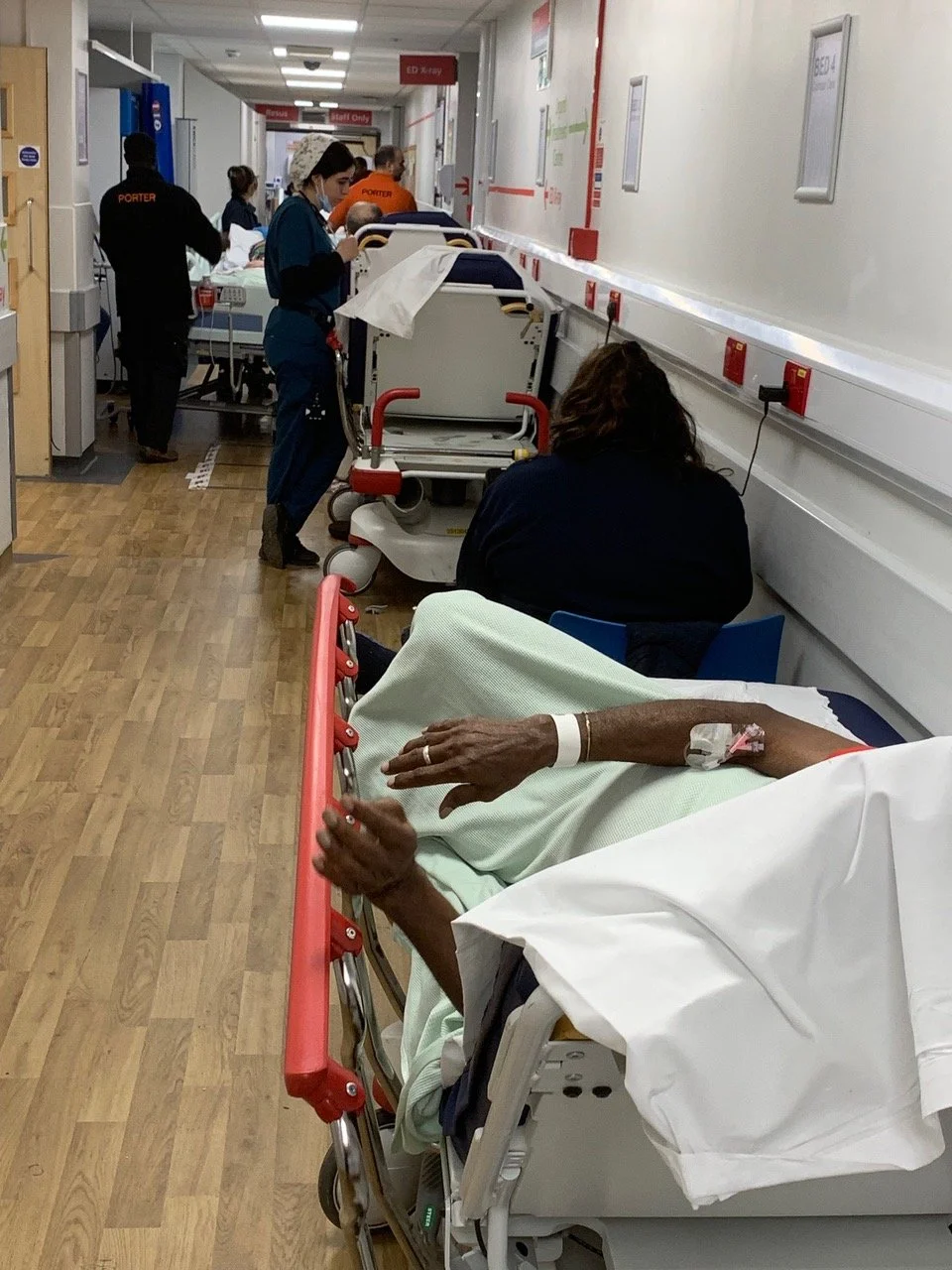
Like most people I assumed that my aunt would be quickly triaged and placed into an appropriate ward for care. What I didn’t expect was to spend two days caring for her in a hospital corridor, waiting for a bed space to become available. I wasn’t unaware of corridor care, but when you experience it first hand, you realise just how horrendous it is.
After being triaged and spending time in emergency care, my aunt was placed on a trolley in an admin office still furnished with computers and desks, with patients on trollies placed wherever they could squeeze them in. It was shocking and looking back I wish I had taken a photo, but I was so stunned that I could only focus on my aunt and supporting her as best as I could.
After eight hours she was moved to a corridor care ward, a sign on the wall assigning her to bed 5 and a small logo letting us know that you get outstanding care every time. I cannot imagine a world in which we would describe corridor care as outstanding, especially not when bodies covered in blue sheets were regularly wheeled past to reach the morgue. We spent eight hours in that corridor and it was traumatic to say the least, with constant beeps and screams meaning my aunt couldn’t hear anyone who called to talk to her on the phone.
The staff were incredibly kind and caring, and I am surprised at how calm they were able to be in the circumstances in which they were working. They were clearly understaffed and trying to provide care in imperfect conditions, halting treatment every time a trolley needed to be wheeled past. Relatives were trying to support and provide care where they could but it wasn’t the kind of place that unwell patients should be in.
We were eventually moved to a triage curtain and spent two nights in this cubicle until a ward bed became available. Once on a ward my aunt received the most fantastic care in a quiet ward where she could pass peacefully.
My aunt didn’t die because of corridor care and her death was unavoidable, but she should not have had to spend her last days in a packed corridor - she deserved to die with dignity.
The NHS needs urgent investment so that no other family has to endure what my aunt and I had to. Without reforms to social care, corridor care will continue to happen, putting people's lives at risk and stripping patients of their dignity. This must be a number one priority of the new Prime Minister and his cabinet.